Murder of Don Fanucci
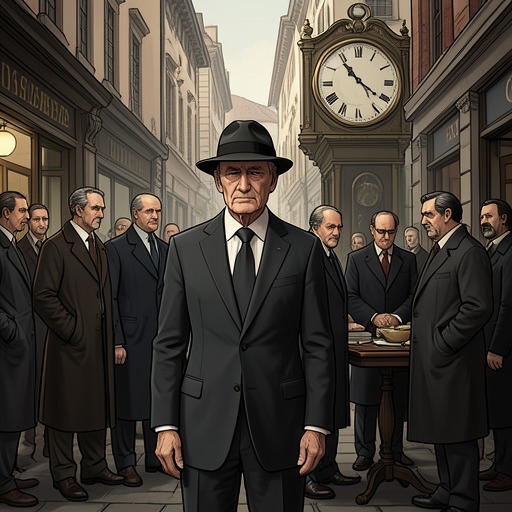
The GodfatherMurder of Don Fanucci marks the turning point at which Vito Corleone chooses power over an ordinary future. Faced with an extortionist demanding seven hundred dollars, Vito decides that Fanucci is not worth preserving at that price. The killing converts Vito from a quiet young immigrant with intelligence and courage into the founder of an authority built on judgment, restraint, and the credible threat of force.
Causes and the Choice of Destiny
Vito Corleone’s decision grows out of his recognition that Fanucci’s power is less substantial than his reputation. Fanucci levies tribute on shopkeepers and gambling games, yet at least one neighborhood gambling operation has never paid him and has suffered no consequence. Fanucci therefore appears to depend on personal brutality and occasional hired gunmen rather than on an invulnerable organization. For Vito, this creates a choice: he can pay the tribute and perhaps return to the life of a grocery clerk, or he can remove the man who blocks his advancement.
The immediate financial calculation is exact. Vito proposes that Clemenza and Tessio each give him two hundred dollars, while he will provide the remaining three hundred dollars demanded by Fanucci. He promises to settle the matter himself, instructing the two men to tell Fanucci that they are willing to pay and that the money will pass through Vito. They must not bargain or quarrel. Vito intends to make Fanucci believe that payment is forthcoming while reserving the confrontation over the price for himself. When Clemenza discovers that Fanucci will accept no less than three hundred dollars from each man, Vito’s plan becomes even more profitable: by refusing the full seven hundred dollars, he can keep the money and eliminate the collector.
The event gives concrete form to Vito’s belief that every man has only one destiny. He understands that paying Fanucci might preserve a modest future, but he interprets the encounter as the force that has placed him on the path toward becoming a Don. His earlier life had already been shaped by violence: after his father’s murder, he had lived under a sentence of death, fled his executioners as a child, crossed the ocean, and taken a new name. Those experiences have convinced him that he possesses greater intelligence and courage than most men, even though he has not yet found the occasion to use them.
Preparation and Execution
Before confronting Fanucci, Vito orders his wife to take Sonny and Fredo into the street after supper and keep them away from the apartment until he gives permission. She is to guard the tenement entrance while he conducts private business. Her fear reveals that the danger is no longer only Fanucci’s. Vito, normally quiet, gentle, and reasonable, has begun to radiate a force that frightens even his wife. He tells her, "Do you think you've married a fool?" The remark is both reassurance and warning: Vito believes the operation is rational, but he also recognizes that he is crossing into a new identity.
Vito tells Clemenza and Tessio that he will reason with Fanucci. The phrase later becomes one of his characteristic warnings. In his mature career, an invitation to reason means that an opponent has been offered one last chance to settle an affair without bloodshed. Here, however, reasoning is partly a tactical disguise. Vito allows Fanucci to believe that the tribute has been secured, fills his glass, and maintains the appearance of respectful interest while studying the man’s movements and confidence.
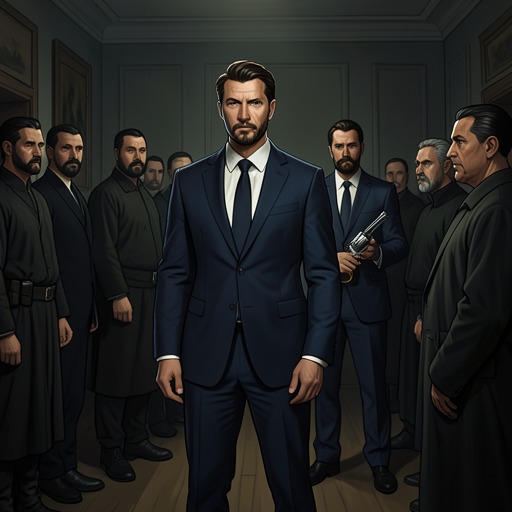
After Fanucci leaves the Corleone apartment, Vito uses the crowded street outside the building as an unintended alibi. He watches Fanucci turn toward his own apartment, then escapes across the connected rooftops, descends a fire escape through an empty loft building, crosses the back yard, and enters the building opposite Fanucci’s tenement. That part of the neighborhood is largely warehouses and lofts near the railroad freight yards, with few residents likely to gossip or intervene. Vito waits in the vestibule with a gun that he has never fired. His earlier experience hunting in Sicily with the lupara gives him some familiarity with firearms, but the weapon in his hand is still an instrument he must use for the first time.
Fanucci approaches through the doorway. Vito fires once, then a second time into the exposed red mark on Fanucci’s shirtfront as the wounded man struggles to remain upright and reach for his own gun. After Fanucci falls to his knees, Vito presses the gun against his cheek and fires into his brain. The entire killing takes no more than five seconds. Its brevity is important: Vito does not indulge in spectacle or anger. He applies force with the same economy with which he has calculated the money, the route, and the risks.
Concealment and Immediate Consequences
Vito removes Fanucci’s wide wallet and returns through the loft building and across the rooftops. He discovers the seven hundred dollars he had expected, along with a few smaller bills. He knows that both the wallet and the gun must disappear, and he takes care to leave a gold piece in the wallet. He empties the gun, smashes its barrel and butt against a roof ledge until the weapon separates into pieces, and drops the parts down different air shafts into accumulated garbage. He then changes clothes, soaks the garments in lye and heavy brown laundry soap, scrubs them on the washboard, and cleans the tub and sink before joining his wife, children, and neighbors outside the tenement.
The precautions prove unnecessary because the police never question Vito. They are pleased by Fanucci’s death and assume it is another gang execution, concentrating their inquiries on known racketeers and men with histories of strong-arm violence. Vito has never been in trouble, and the police do not connect him with Fanucci’s final visit to his home. The official response exposes the weakness of the public order around him: the authorities are less interested in solving the murder than in accepting the disappearance of a man they regard as part of the criminal underworld.
The more important test comes from Clemenza and Tessio. They avoid Vito for one or two weeks, then return with unmistakable respect. Their conduct confirms that the murder has altered their understanding of him. Fanucci had seemed dangerous enough to command tribute, yet Vito has removed him without being arrested and has preserved the money. The killing therefore establishes not merely Vito’s courage but his superior assessment of risk, making him the natural center of the small criminal enterprise.
From Private Killing to Organized Power
The Fanucci murder becomes the foundation for Vito’s subsequent organization. He protects Italian families operating small speakeasies, accumulates knowledge and contacts, and builds goodwill through deliberate acts of friendship. When Genco Abbandando’s lawyer establishes a payoff list for officials in the Police Department and judiciary, Vito rejects efforts to limit the list to immediately useful contacts. He insists that everyone be included, even officials who cannot help the organization at once, because he is willing to demonstrate friendship before demanding its return.
As the enterprise expands, Vito turns informal loyalty into a layered structure. He appoints Clemenza and Tessio as caporegimes, places soldiers beneath them, and names Genco Abbandando as Consigliere. Orders pass through buffers so that operational acts cannot easily be traced to the head of the family. Tessio’s group is assigned responsibility for Brooklyn and separated from Clemenza’s Bronx operation; Vito makes clear that the two caporegimes should not associate socially except when necessary. The separation is not personal hostility but a security measure against conspiracy, while Clemenza’s greater recklessness and cruelty lead Vito to keep tighter control over him.
The same logic is later visible in Tom Hagen’s appointment as Consigliere. Vito breaks the long-standing tradition that the position must belong to a full-blooded Sicilian, choosing Hagen because he has been raised as part of the family and can serve as counselor, closest companion, and intermediary between policy and operations. The Consigliere’s position depends on absolute loyalty: he knows nearly everything the Don knows, yet the chain of command protects the head of the family unless every link turns traitor. The institutional form that emerges after Fanucci’s death thus preserves the personal authority first demonstrated in the vestibule while making that authority harder to expose.
Historical and Narrative Significance
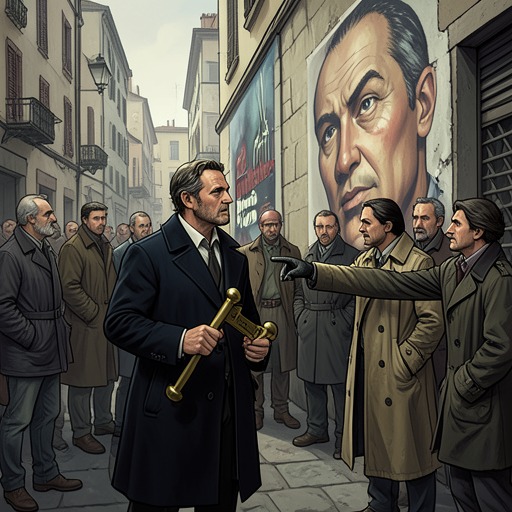
The murder is not an isolated criminal episode but the origin scene of Vito Corleone’s public identity. During the Great Depression, when honest men cannot find work and families are humiliated by official charity, Vito’s men walk with money and security. Employees sent to prison have their families supported. His organization becomes an alternative source of employment, protection, and dignity, and the neighborhood’s dependence helps transform the killer of Fanucci into Don Corleone, a figure whose authority is described through favors and friendship as much as through violence.
The event also establishes the central contradiction of Vito’s rule. He presents himself as a protector who never disappoints those who proclaim friendship, and people repay him with respect, the title of Don, and the acknowledgment that they are in his debt. Yet the system of favors is backed by the capacity to make people disappear. Fanucci’s death shows the hidden exchange beneath the benevolent surface: Vito protects his world, but he also controls it, and the debt created by protection can be redeemed through service.
Years later, the consequences reach beyond Vito’s personal rise. When Vito announces his semiretirement and Michael Corleone takes control, the Corleone Family faces a succession crisis because leadership is not automatically hereditary; powerful caporegimes such as Clemenza and Tessio might otherwise inherit power or separate into independent families. After Michael’s political maneuvering, the family becomes unchallengeable, Clemenza has his own Family, Rocco Lampone serves as Michael’s caporegime, Albert Neri commands security for the family-controlled hotels in Nevada, and Tom Hagen belongs to Michael’s Western Family. The final shape of that power can be traced back to the first decisive demonstration that Vito’s private judgment could replace the authority of the man everyone else feared.